
 Salomon LundquistArticles, English
Are today's ports ready for tomorrow's mega ships?
As container ships exceed 24,000 TEU, ports face severe dredging and hinterland bottlenecks. We examine whether offshore floating terminals offer an efficient and sustainable alternative.

Container ports around the world are fundamentally unprepared for the compounding onshore demands of modern ultra-large container vessels. While carrying capacities have tripled from 8,000 to over 24,000 TEU in two decades, the physical geometry of coastal harbours, approach channels, and hinterland corridors cannot stretch indefinitely. The critical bottleneck of global container shipping has shifted decisively from blue-water vessel transit to landside terminal access. Solving this crisis requires abandoning endless coastal dredging in favor of floating transshipment infrastructure.
Key takeaways
- Vessel scaling has outpaced shore infrastructure: Container ships carrying 24,000 TEU require 16.5 to 17 meters of draft and specialized ultra-post-Panamax cranes, which fewer than 5% of global ports can accommodate without ongoing capital dredging.
- Onshore costs negate maritime economies of scale: Research by the OECD/ITF demonstrates that the incremental vessel operating savings of mega ships are routinely erased by skyrocketing shore expenditures on dredging, berth reconstruction, and yard congestion.
- Disproportionate peak volume strains hinterland transport: Unloading 5,000 to 8,000 containers during a single port call overwhelms yard crane capacity and coastal highway and rail arteries, amplifying supply chain volatility.
- Offshore transshipment provides a modular escape hatch: The Sea Tech Floating Terminal (STFT®), engineered with DNV Approval in Principle, handles ultra-large container vessels in deep natural water, transferring containers directly to regional feeders and bypassing coastal physical limits entirely.
Vessel scaling: how 24,000 TEU giants outgrew coastal geography
Commercial container shipping has undergone a rapid physical transformation that has severed the historic balance between vessel size and harbour capacity. Two decades ago, an 8,000 TEU vessel was considered the absolute frontier of maritime naval architecture. Today, the world's premier trade lanes are dominated by ultra-large container vessels exceeding 24,000 TEU, spanning 400 meters in length and over 61 meters in beam.
Ocean carriers commissioned these colossal ships to secure economies of scale across open oceans. A single 24,000 TEU vessel uses significantly less fuel and produces lower carbon emissions per container slot than three 8,000 TEU ships traversing the Asia-Europe or trans-Pacific corridors. In deep international waters, scaling ship capacity remains an effective operational strategy.
However, these maritime efficiencies rely on an unexamined assumption: that shoreside facilities can continually expand to receive them. When a 24,000 TEU ship approaches a coastline, its 16.5-meter operating draft encounters ancient geological barriers. Most legacy ports were built inside sheltered river estuaries or shallow bays that were never formed to support modern naval dimensions.
Port authorities have historically reacted to expanding hulls by digging deeper approach channels and pouring more concrete. Yet physical geography imposes strict boundaries on civil dredging, while local marine ecosystems restrict endless coastal encroachment. The shipping industry has effectively maximized naval vessel size, but in doing so, it has pushed traditional ports beyond their geographic tolerances.
Infrastructure bottlenecks: why dredging and cranes cannot fix onshore congestion
Accommodating an ultra-large container vessel requires far more than merely deepening an entrance canal. Berthing a 400-meter ship demands reinforced quay walls, continuous dynamic under-keel clearance, massive ship-to-shore cranes, and vast contiguous container yards capable of absorbing sudden cargo tsunamis. Traditional civil port modifications have become too slow and expensive to keep pace with fleet expansion.
Capital dredging represents the most severe financial and operational burden. Deepening navigation channels to 17 meters requires removing millions of cubic meters of marine sediment, often containing industrial contaminants from centuries of maritime traffic. Disposing of this material triggers multi-year environmental reviews, fierce municipal resistance, and relentless litigation that frequently stalls terminal expansion projects for over a decade.
Terminal equipment presents an equally demanding obstacle. Handling vessels stacked 24 containers wide demands super-post-Panamax cranes with outreaches exceeding 70 meters. These cranes weigh over 1,800 tonnes each, generating ground-bearing pressures that exceed the load capacities of legacy quays. Terminals must drive deep foundation piles and rebuild their electrical substations simply to support the physical weight of modern handling gear.
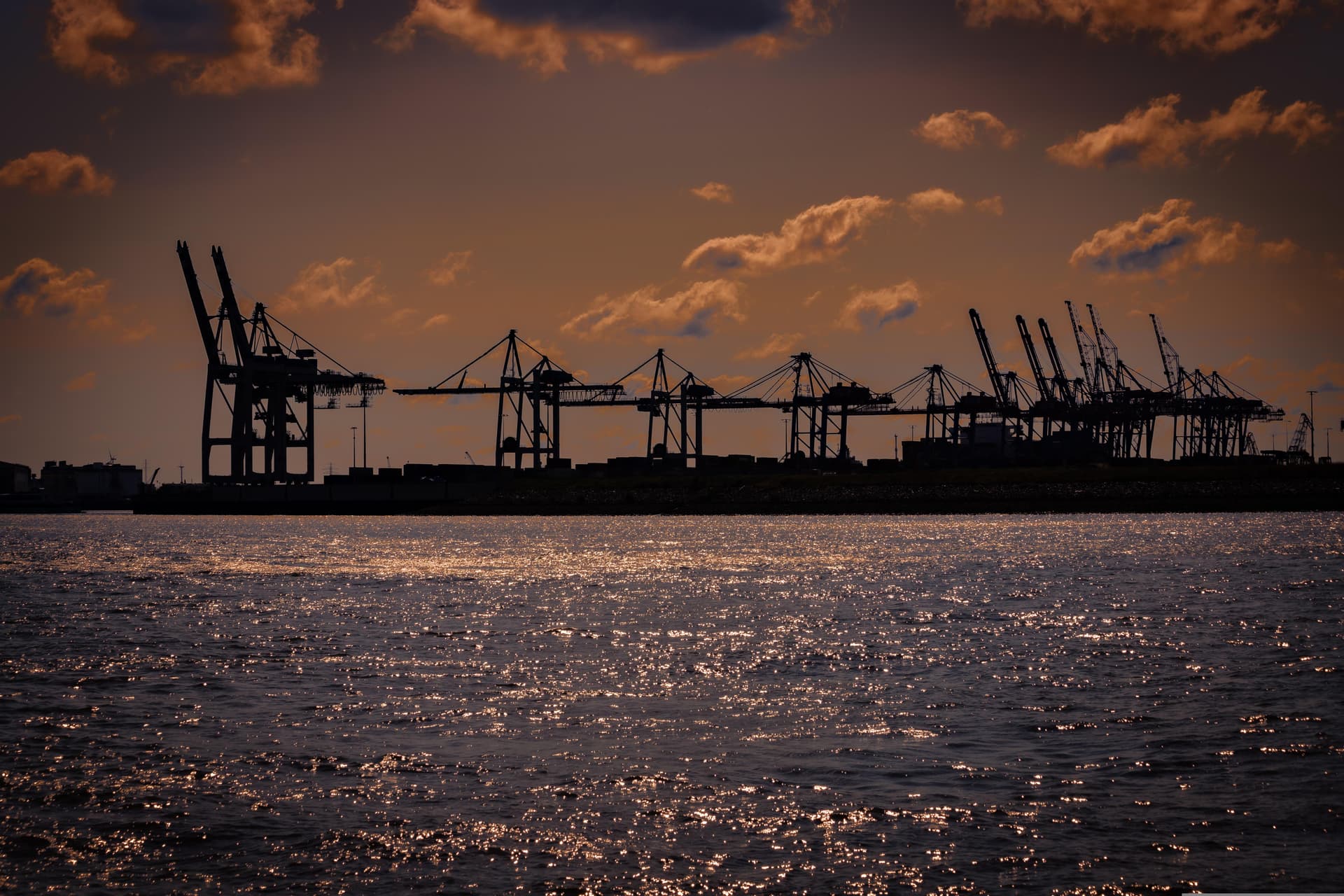
The most intractable bottleneck occurs in the container yard and hinterland transit corridors. When an 8,000 TEU vessel called at a port, container discharges were spread across balanced operational cycles. A 24,000 TEU vessel concentrates thousands of container moves into a single 48-to-72-hour window, overwhelming gate complexes, staging yards, rail links, and local road networks.
Port authorities evaluating long-term berth expansion can explore the Sea Tech Floating Terminal specifications to assess modular deep-water alternatives to capital dredging.
Economic trade-offs: why mega-ship savings erode at the quay
The maritime economies of scale generated by mega container ships are now largely negated by escalating costs across ports, terminal operations, and hinterland supply chains. While carrier balance sheets show lower slot costs at sea, the global logistics system absorbs massive capital investments on land to keep those vessels operational.
According to comprehensive economic analysis published by the OECD's International Transport Forum, the cost savings generated by mega ships follow a law of diminishing returns. The study revealed that while transitioning from 4,000 TEU to 10,000 TEU produced meaningful transport cost reductions, further scaling past 18,000 TEU generated marginal vessel savings that were routinely wiped out by higher costs in port adaptation and hinterland delays.
Data from the UNCTAD Review of Maritime Transport 2025 confirms that global shipping networks are facing chronic port congestion, schedule unreliability, and elevated transport costs. When mega vessels experience delays along disrupted shipping lanes, their arrival spikes trigger severe terminal gridlock, driving up container dwell times, storage fees, and demurrage expenses for cargo owners worldwide.
This dynamic creates a profound economic misalignment between private shipping lines and public infrastructure providers. Carriers capture private fuel efficiencies by commissioning ever-larger vessels, while municipal port authorities and public taxpayers are expected to subsidize the billions required for channel deepening, bridge raising, and highway widening. Without a structural shift in terminal strategy, coastal authorities will continue subsidizing a shipping model that works against their geographic realities.
Offshore transshipment: can floating hubs bypass coastal limits?
Offshore transshipment solves port congestion by relocating container handling operations to deep, sheltered coastal waters where water depth is unlimited by nature. Instead of forcing mega vessels into narrow coastal estuaries, ultra-large ships dock alongside modular floating platforms to transfer cargo directly onto regional feeder vessels, eliminating dredging requirements entirely.
By handling mega ships in deep water and connecting regional ports through feeder vessels, new infrastructure models reduce dependence on extensive coastal expansion. Sea Technology is pioneering this transition through the Sea Tech Floating Terminal (STFT®), a modular steel offshore platform engineered specifically for container transshipment and multi-modal logistics.
The STFT platform received Approval in Principle from DNV in 2025 for offshore floating infrastructure installation. Engineered to provide 5 to 6 million TEU of annual container throughput, the platform services vessels up to 24,000 to 30,000 TEU without requiring a single cubic meter of capital seabed excavation. By shifting the transshipment interface offshore, regional ports with standard 10-to-12-meter drafts can receive container flows via feeder vessels without expensive dredging campaigns.
Environmental performance is integrated directly into the floating terminal design. The platform incorporates 100 MW clean-fuel generator sets capable of operating on hydrogen, ammonia, or methanol, delivering zero-emission power for high-speed ship-to-shore gantry cranes while providing cold-ironing shore power to berthed container vessels. Terminal operators gain high-volume deep-water capacity while advancing maritime decarbonization targets.
To learn how modular floating platforms handle 24,000 TEU vessels without coastal civil works, explore the Sea Tech Floating Terminal specifications.
Comparative models: coastal capital expansion versus modular floating terminals
Deciding how to accommodate next-generation container ships requires evaluating the structural differences between traditional land reclamation and floating marine infrastructure. Port operators and national transport planners must weigh capital expenditure, environmental permitting timelines, operational risk, and long-term geographic flexibility.
- Project delivery schedules: Expanding a traditional coastal container terminal requires 8 to 15 years of geotechnical investigations, environmental impact statements, community consultations, and phased dredging cycles. Modular floating terminals are manufactured concurrently inside commercial shipyards and installed on-site in under five years.
- Capital expenditure and civil risk: Conventional dredging projects carry severe financial risk from seabed settlement, underwater rock blasting, and contaminated sediment containment. Shipyard-built floating terminals feature standardized modular concrete caissons with fixed fabrication budgets and predictable construction timelines.
- Environmental footprint and seabed impact: Capital dredging destroys delicate benthic ecosystems, permanently alters hydrological currents, and generates heavy siltation plumes. Floating terminals anchor using high-holding mooring spreads that leave the marine seabed largely undisturbed.
- Asset mobility and climate resilience: Coastal concrete berths represent permanently fixed assets vulnerable to sea-level rise, tectonic shifts, and changing trade routes. A floating terminal naturally rises and falls with tides and storm surges, and the entire facility can be relocated or reconfigured as global trade lanes shift.
Traditional port expansion treats land and concrete as the only permanent solutions to maritime growth. In reality, floating modular infrastructure allows us to build deep-water capacity at the speed of shipyard production rather than the speed of civil dredging permits.
Frequently asked questions: mega-ship handling and floating infrastructure
Can floating terminals maintain crane stability in open waters?
Floating terminals maintain crane stability through heavy steel modular caissons engineered with low centers of gravity and active dynamic ballasting systems. These platforms damp wave motion to within strict operational tolerances, allowing standard container gantry cranes to operate safely under adverse sea states.
How do floating hubs distribute cargo to secondary coastal ports?
Floating hubs distribute cargo through synchronized regional feeder loops and specialized barge systems. Once an ultra-large vessel unloads at the offshore platform, containers are sorted directly into shallow-draft feeder ships that service regional river and coastal ports without requiring channel deepening.
What water depth is required to deploy a floating container terminal?
A floating container terminal is typically deployed in sheltered or semi-sheltered coastal waters with natural depths of 25 to 50 meters. This depth provides complete draft clearance for 24,000+ TEU vessels with zero dredging, while remaining shallow enough for conventional catenary or taut-leg mooring systems.
Terminal operators and logistics planners can explore the Sea Tech Floating Terminal specifications to evaluate water depth, mooring parameters, and operational throughput.
Strategic outlook: building resilient maritime logistics networks
The physical competition between expanding container ships and coastal port geography has reached its economic limit. Ocean carriers will not abandon mega vessels because the maritime fuel efficiencies of scale are indispensable in a decarbonizing world. However, expecting every coastal city to deepen its channels, rebuild its quays, and endure chronic traffic gridlock is an unsustainable development model.
Building resilient maritime supply chains requires decoupling deep-water vessel calls from shallow coastal geography. By deploying offshore transshipment hubs in natural deep waters, maritime networks can preserve ocean-going scale while distributing cargo to regional ports through agile, shallow-draft feeder vessels. Logistics systems become more flexible, resilient to disruptions, and less vulnerable to localized port shutdowns.
The future of maritime trade depends less on building bigger coastal ports and more on building smarter logistics networks. Forward-looking terminal operators and transport ministries are already exploring how floating infrastructure can solve immediate capacity constraints. For deeper analysis on how modular platforms are transforming sea-based logistics, read our previous exploration of why floating ports will shape tomorrow's maritime infrastructure.
To evaluate technical parameters for your regional trade corridors, explore the Sea Tech Floating Terminal specifications or contact our naval engineering team to discuss custom feasibility assessments.
Salomon Lundquist
Business Development Manager
Salomon drives Sea Technology's business development, opening conversations with ports, shipowners, and energy operators, and turning the firm's engineering work into long-term partnerships. He advises on commercial strategy across the STFT, floating nuclear, and barge carrier programmes.