

OFFSHORE TRANSSHIPMENT
How an offshore container transshipment hub works
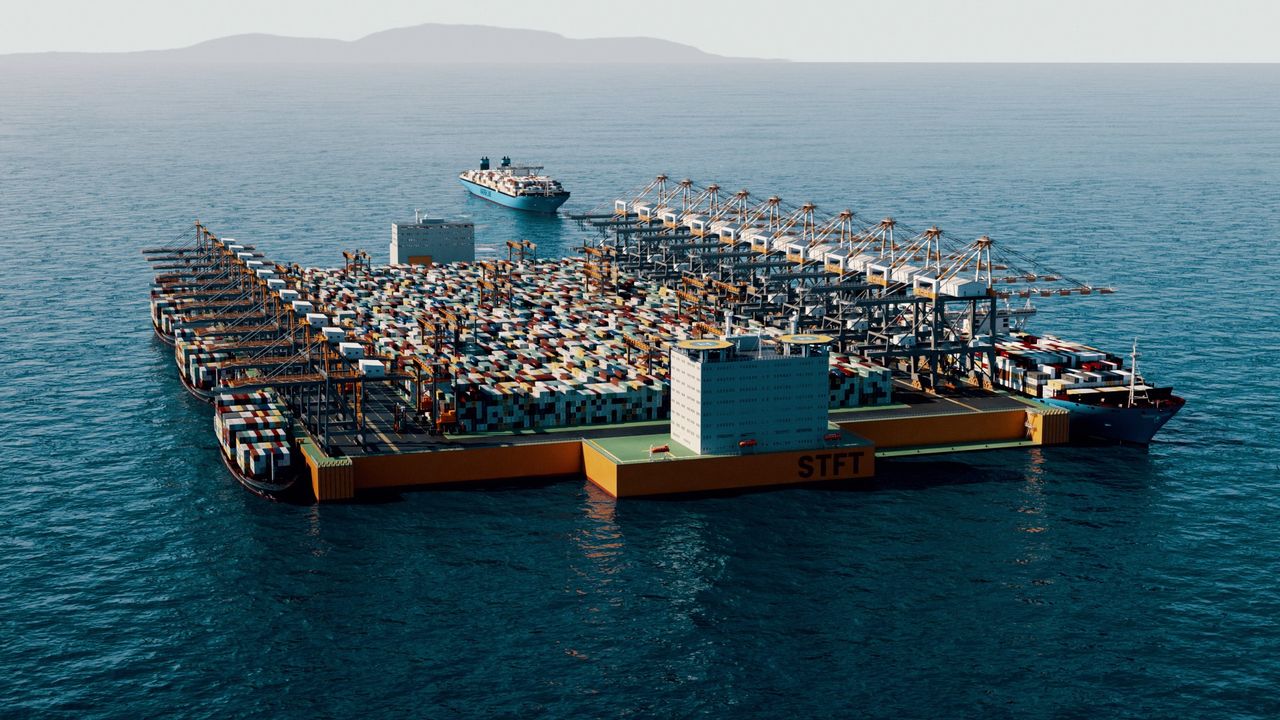
A container port can be built offshore. The largest ships berth at a floating platform in deep water, and feeder vessels carry the containers to shore.
The Sea Tech Floating Terminal holds a DNV Approval in Principle.
The ships no longer fit the shore
Only about 20 to 25 ports in the world can berth today’s ultra-large container ships. Their quay walls, bollards and channels were built for a smaller fleet: a dynamic mooring analysis at the Port of Rotterdam measured mooring loads beyond 240 tonnes on lines and bollards.
An offshore hub moves the berth to where the depth and space already are. The large ship makes one call at the hub, and smaller feeders take the cargo the last stretch to the ports that need it.
HOW IT WORKS
One container's route through the hub
Five stages, all on one floating platform.
The ship moors offshore
An ultra-large container ship comes alongside the floating quay, where Cavotec MoorMaster automated vacuum mooring holds it in place.
Cranes unload it
Megamax ship-to-shore cranes with 80 metres of outreach work the vessel at full ULCV scale.
Containers wait in the yard
Boxes are stacked on the platform's own container yard until their feeder arrives.
Feeders carry them on
Feeder vessels load at the hub and sail direct to regional ports, bypassing road congestion and last-mile bottlenecks.
The platform powers itself
Generator sets capable of hydrogen, ammonia and methanol supply the cranes and the platform, with freshwater production and waste-to-energy on board.
ON THE PLATFORM
Everything a port needs, on one floating structure
The systems that turn a floating platform into a working transshipment hub.

Floating quay
A berth for ultra-large container ships in water up to 1,000 metres deep, with no dredged channel to reach it.
Ship-to-shore cranes
Megamax STS cranes with 80 metre outreach, handling 5 to 6 million TEU a year on one platform.

Clean power
100 MW of clean-fuel generation, ready to supply ships at the quay so they can shut down their engines.

Container, RoRo or hybrid
The same base can carry a RoRo configuration with garage and deck space for cars, or be paired with the Floating Nuclear Power Plant.
AT FULL SCALE
One hub, in numbers
On a single floating platform.
Megamax STS cranes for ULCVs.
Hydrogen, ammonia and methanol capable.
Anchored, not founded on the seabed.
VALIDATED BY
Independent engineering and research partners


Offshore transshipment, in brief
The questions shipping lines and port planners ask about building a port offshore.
Yes. The Sea Tech Floating Terminal is a modular floating port that is built in a shipyard, towed to its site and anchored in water up to 1,000 metres deep. DNV issued it an Approval in Principle in October 2025, under its Floating Infrastructure Installation class notation.
By feeder vessel. Containers are unloaded from the large ship, stacked in the platform's yard and loaded onto feeders that sail direct to regional ports.
A conventional hub needs a dredged channel, a fixed quay wall and reclaimed land, and takes fifteen to twenty years to build. The floating hub needs none of them and is operational in under five years.
5 to 6 million TEU a year on a single platform, comparable to a Rotterdam-class terminal.
No. 100 MW of on-board generation, capable of hydrogen, ammonia and methanol, powers the cranes and the platform. Grid connection is an option where the site allows it.
Yes. Barge Carrier Systems move the hub itself: a mother ship carries floating satellite barges and transships by float on, float off, with no cranes or dock.
NEXT STEP
Discuss a hub on your trade lane
We work with shipping lines, port authorities and government delegations evaluating offshore capacity.
First conversations are confidential.